Jun 12, 2019

June 12th 2019 - Quiet Lab.

For the remaining duration of the field school, students will be spending most of their time working on their projects in the lab or at home. Bob opened up the lab at 8:30 in the morning, and two students were waiting and ready to work. As time went on, more students trickled in if they needed items from the lab to work on their projects.

Karoline looked through and recorded items in the last bag of project waste from when students deconstructed camp yesterday. Angus came in to get Bob's opinion on the rough draft of his written report on industrial artifacts, which Bob happily did. Phoenix also came into the lab to work on his report on bottles found at the McKenzie Creek site, and Ali continued working on line drawings of artifacts all day.
Ali working on line drawings.
I spent the day going through level bags and creating tables in a word document of their contents. I finished looking through all of the bags, and I am over half-way done the written report. We have a total of 42 bags from the 2019 field season.
Looking through past level bag reports and writing up my own.
Rohan worked on his report on buttons and clasps in the lab as well. So far he has over 3000 words in his report. There is lots to know about the different types of buttons found at the McKenzie Creek site, and the materials they pair with. Shaunti is helping Rohan research a certain brand of work overalls that he believes pair with a few buttons in the collection.

Again, Nikki spent all day photographing artifacts from the McKenzie Creek site. Sepideh also dropped in this afternoon to get some pictures from Nikki for the video.

Bob spent some time clearing out the lab storage room that is filled with field equipment and projects from past years. In the late morning, he pulled out maps from field projects he has worked on in the past, and some maps from the early stages of the Seymour Valley Archaeology Project. He offered the maps that he no longer had use for to students working in the lab, and a few people took him up on the offer. Interestingly, Bob stumbled upon a few maps from Ontario, and they just happened to be of Nikki's hometown, so she got to keep those ones!
Bob and Nikki looking for maps. 
Bob clearing out the lab storage room.
Some students also spent time working on their projects at home. Mitch finished up drawings of the rock feature and scanned them on to the computer. Aza also got a lot of work done on the sketch of the cedar plank road. She finished taking measurements yesterday in the field, and now has everything she needs to draw her pictures to scale.
Sketch of the rock feature done my Mitch.
Most people were very focused on working today, which provided a quiet and peaceful lab to work in. Hopefully we will all be just as productive tomorrow as we were today.

Jun 11, 2019

June 11th 2019 - Packing Up.

Today has been a productive day for many. Just over half of the students worked in the lab to try and get as much of their project done as they could. The other students spent the day in the field, breaking camp and finishing up measurements for sketches and final reports.

In the field, students dissembled both of the tents, the picnic tables and moved all of our project supplies back to lab with two trips in Bob's car. Some also helped backfill the excavation units that we closed last week.
Angus, Aza and Mitch deconstructing the tent. Photo by Bob.
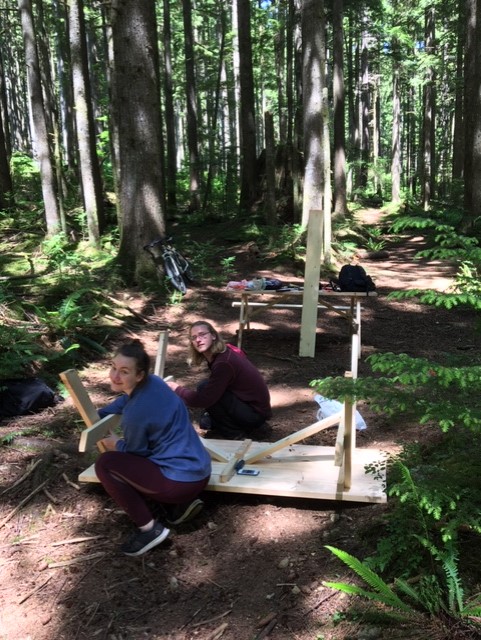
Phoenix and Kirsten taking apart the picnic tables. Photo by Bob.
Alyssa, Aza and Mitch filling our excavation units back up with dirt. Photo by Bob.
In the lab, Ali spent the day working on line drawings of artifacts. She spent the first two hours working on sketching the bottle that Mitch found last Thursday, which we now know is most likely not a toothpaste tube. It has "Bauer and Black" and "Toronto" engraved on the lid which lead us to believe that it was some type of medical ointment made by the Kendall Company in the 1920s or 1930s. Allyah is researching more in depth about the tube, so hopefully we can narrow down the date. Ali has also started a sketch of a teapot from the Hastings Seymour camp.
Line drawings done by Ali of the Bauer and Black tube.
Yesterday I mentioned that Ali has been working hard on sketches from the field as well, so I thought I would share one of her favourites with all of you. This is a drawing of Mitch working at the Rock Feature from a few weeks back. Everyone is excited to see more sketches from her!
Ali's sketch of Mitch.
Fazila finished measuring, recording and taking pictures of all of the ceramics from the McKenzie Creek site today. Allyah helped her take the pictures while she focused on measuring the diameter of each rice bowl with callipers.
Fazila recording and measuring ceramics.
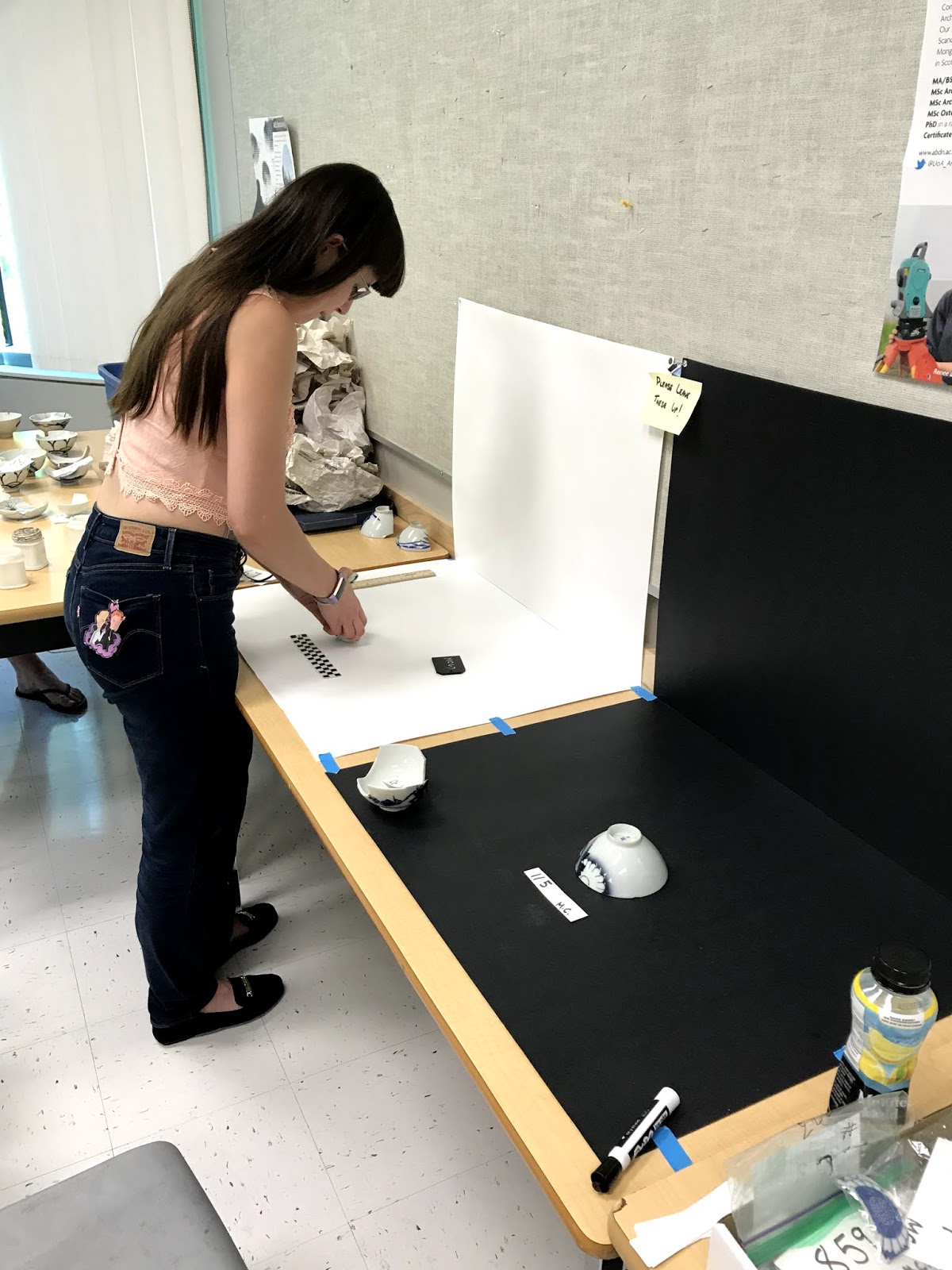
Nikki spent all day with her camera, and artifacts from McKenzie Creek. She worked on getting pictures of ponds jars and ceramics on the white and black backgrounds she created. Sepideh also wants to add images of buttons and toothbrushes to the video she is creating, so Nikki also worked on taking those this afternoon.
Nikki taking pictures on black and white backgrounds. 
A collection of ponds cold cream jars from McKenzie Creek.
I focused on looking through level bags that we created in the 2019 field season. We had bags from each of the 7 open units, and also a few bags from test pits done around the site. I managed to go through over half of the bags, removing all of the contents of each, recording them, and weighing the flat sheets of metal that were found. When I finish going through all of the bags, I will put all of the information into one document so it will be easy to see the contents of each level bag without looking through them.
Recording the contents of 2019 level bags.
Siobhan spent the day researching a few artifacts that Bob assigned for her to look into. She did a lot of research on Colgate toothpaste, because previous field seasons found some tubes on the site. She narrowed down the date of the toothpaste tubes to have been manufactured between 1914-1928 from the broader date of 1857-1928. In the afternoon she also started researching ponds cold cream jars. 
Siobhan researching ponds cold cream jars.
Overall the day went very well, and many students were very productive! Tomorrow most students will be working from home or in the lab, but there is the chance that Bob could take a few students to another site in the Lower Seymour Conservation Reserve. Check out tomorrow's post to see what happens!


Jun 10, 2019

June 10th 2019 - Crunch Time.

This morning all students met in the lab to begin our weekly discussions. Last week we didn't have a day where everyone was in the classroom together, so it was nice to all meet and give updates on our projects.

We started the day by talking about our grades for the course, and about the final exam that was supposed to occur next week. Bob mentioned how over the weekend he was contemplating whether or not students should have to do the final exam this field season. In previous years, students would fill out a site inventory form and create a map of a site that was unfamiliar to them. In recent years, the form has changed substantially to where it would be hard for a non-archaeologist to complete it with little information on the site. Bob also mentioned that to do well on the exam you need to have practice with mapping, which takes up a lot of time. He said it may be better for students to have lab time to work on their projects, so he proposed to change how the course is weighted. Our class unanimously decided that we will weigh professionalism and field notes more heavily, and spend more time perfecting our projects, rather than doing the final exam.

After having a long discussion about that, Bob mentioned that he visited the Burnaby Village Museum on Saturday, and got the chance to view the ofuro they have there. If you want to see some pictures of the re-opening of the ofuro in 2015, you can check it out here. If you live in the lower mainland and want to visit the Burnaby Village Museum, you can find information about when they're open on their website.
The ofuro at the Burnaby Village Museum. Photo by Bob.
Next, we began giving updates to everyone on the progress of our projects. So far Nikki has taken 1800 photos of artifacts and almost 2000 pictures of the site. Shaunti, Siobhan, and Allyah have all been researching artifacts found at the McKenzie Creek site, and Rohan has finished measuring the diameter of all buttons, and described the materials that they were made with. Mitch and Alyssa are working on their sketches of the rock feature and ofuro. Alyssa will be in the field tomorrow taking some final measurements of the rocks at the ofuro, and Mitch will be working on his drawings. Ali has completed 4 sketches of students working and has 3 more on the way. She will also be doing some line-drawings of artifacts found in the field. Angus and Phoenix have found minimum numbers of barrel rings, lanterns and bottles. So far, Angus has come up with 12 barrel rings and 12 lanterns, and Phoenix has found over 90 bottles. Harman has finished cataloguing 500 artifacts, with 300 still left to do. Once she is done with her written catalogue, she will be putting everything into an excel spreadsheet. Fazila finished measuring and recording information about ceramics from the Suicide Creek site, and she will now be working on tableware found at the McKenzie Creek site. Kirsten is almost finished writing up her report on plant life at McKenzie Creek, she is just looking at satellite images to create a map of the foliage. Aza has a few more measurements to do tomorrow on site of the cedar plank road, and then she can finish up sketches for her report. Karoline has started writing her report on the waste audit, but she will need to wait until camp is broken down to get the total amount of garbage produced by the project. I am also starting a small project on the side of the blog, creating a report on the level bags from 2019 excavations. We are all working hard to get our projects done quickly and neatly.

Bob also mentioned during our round-table discussion that he has been emailing back and forth with Lisa from the Nikkei Museum who visited our site last week. She has been thinking about the possible uses of the rock feature that Mitch is working on, and says that it could have been a washing station due to its close proximity to the creek. Hopefully we can do some more research on that type of structure in the future to try to figure out what the purpose of the rock feature on our site is.

After lunch, a few students travelled with Bob to the Suicide Creek site. Ali, Aza, Nikki and I all went into the Lower Seymour Conservation Reserve with the task of finding the site that Bob hadn't visited for a decade. Luckily with Bob's permit we were able to drive up to the area where the site is, so we didn't have to walk over 10 kilometres from the parking lot.
The road to get to the Suicide Creek site.
Once we got there, Bob pointed out how overgrown it has gotten since the last time he visited it. He said there used to be a clear path to get to the site, and today there was definitely no clear path. We travelled through thick shrubbery to get to the site, climbing over and under fallen trees and branches. It took us about 15 minutes to walk to and find the site, where Bob gave us a tour of the major features. Among other things, he showed us a cedar plank road that ran into the site, many artifacts that he had put back on the site once they were catalogued by students in past years, the suspected flooring of a mess hall, and a saw that had grown into a second growth tree.
Bob showing Aza a cedar plank road that runs into the Suicide Creek camp. 
Ali standing on the possible floor of a mess hall somewhat covered by a fallen tree.
Artifacts put back on site after Bob was finished working at Suicide Creek.
Saw blade that has grown into a tree. Photo by Nikki.
Finding our way back to the car was a little bit more difficult as there was very rough walking terrain, and no path to follow. Aza stayed at the front of the pack for most of the hike back, coming out with a a couple of wasp stings.
Aza and Bob walking through trees and ferns to get back to the car. 
Tomorrow half of the students will be in the field breaking camp and finishing up some measurements, while the other half are working in the lab on their projects. If there are any student projects that you seem very interested in and want to learn more about, feel free to leave a comment down below and I will try to include some more details about it in a future post!

Jun 6, 2019

June 6th 2019 - And Then There Were Six.

Today was the last day of excavation in the field. Only six students hiked into the field today, while all others worked in the lab. Many began writing and drawing up reports for their final projects in the classroom, while students in the field focused more on finishing up excavations. On the McKenzie Creek site, we have a total of 7 open units. We wanted to be able to close all of them today, but before they're closed, we made sure the unit hit a sterile layer. When a unit is sterile, it means there is no more evidence of culture such as nails or glass. In the morning, Nikki, Karoline, Mitch and I took our buckets and trowels to our excavation units to get as much done as possible. Aza continued to work on her cedar plank road project, while Alyssa spent time measuring and finishing up sketches on the ofuro.
Mitch sifting dirt in a beam of light. Photo by Nikki. 
Nikki found a rock feature in her unit last week, and she spent a couple of days excavating around it. Today she had the chance to remove the rock feature from her unit, and surprisingly she found the tops of some bottles underneath it. She mentioned that they are likely the tops to bottles that she found a few days ago in the unit. She also got to remove some cans that Sepideh found in the unit next to hers, so that we could close it.

In the eastern units, Mitch found the cap of a tube of toothpaste 40cm below the pit datum. While he was sifting through the dirt from that area, he also found the rest of the tube rolled up in a tight cylinder. He also managed to find a complete aqua glass bottle with the stopper buried 60cm below the pit datum in his unit. He was on a roll today!
Top of a tube of toothpaste found by Mitch.
Bottle found by Mitch.
Karoline and I found almost 100 nails between 20cm and the sterile layer in our 2 by 2 meter unit. We also found an incomplete file, some broken pieces of glass and a large metal bolt with the nut still attached.
Four eastern units.
We also had some guests visit us in the morning. Lisa Uyeda and Trevor Wideman from the Nikkei Museum and Archives came by to visit the site. Bob was very excited to talk to them about what has been found on the site, and the insight they had to offer.
Bob, Lisa and Trevor looking at artifacts.
Lisa provided extremely useful thoughts about what may have been happening at the camp, such as it being mainly for women and children while the men travelled to work in the surrounding valley area. There is another Japanese camp about 4km away from the McKenzie Creek site that was shown to be occupied by mostly males, which fits perfectly with her suggestion. She also explained to Bob about how the Japanese prepared for internment, by telling him what items people would choose to take with them, and what they would decide to leave behind. If you want to follow her on twitter you can do so here. Trevor has been working with documents that were recently donated to the Nekkei Museum that belong to Tadashi (Jack) Kagetsu, who was the son of the person who established the McKenzie Creek camp. Bob was pleased when Trevor told him that he had letters and emails that were made between Bob and Tadashi before his death about 10 years ago. If you want to follow Trevor on twitter you can do that here.

After our lunch break, everyone went back to excavating with the exception of Aza, who continued to finish up her measurements of the cedar plank road. Alyssa joined us in the eastern units, finishing up excavating what was previously Phoenix's unit. She found a few nails and bits of glass along with a large piece of barrel ring.

Overall the day went quite well and we got lucky with sunny weather once again! Bob said that this is one of the driest field seasons he has ever had in the Lower Seymour Conservation Reserve, with a record of only ONE day of rain so far! On Monday we will all be in the lab, and everyone will be jumping into their projects to try and get them done.


Jun 5, 2019

June 5th 2019 - We're in the News!

Today was a short day in the field for some, and a day where you worked in the lab or from home for others. Many students spent the majority of the day working on their projects that have to be finished in two weeks! Time is flying by so quickly, and it is hard to believe that our field school is almost over.

Yesterday, I created a list of all of the level bags from the McKenzie Creek site with ceramics and bottle/lantern glass in them using reports from previous years. Bob printed that list out so students who need glass or ceramics for their project can go and find pieces in level bags from previous years. Phoenix was in the lab today working on his project of figuring out a minimum number of bottles on the McKenzie Creek site, and he used the list to find bottle glass in bags that date all the way back to 2004.
Phoenix looking at bottle glass from level bags. Photo by Nikki.

Harman was also in the lab again to work on the master list of artifacts in our collection. She has been working so hard by looking through every artifact list from the McKenzie Creek site, and checking to see if we still have all the artifacts in our collection. She will be creating a digital list with over 800 artifacts on it, and stating whether they are stored in the lab, another location, or if they are missing. When Harman is done, it will be very easy for Bob and others to find artifacts from the McKenzie Creek site!
Harman creating the master artifact list. Photo by Nikki. 

Sepideh is also working very hard on the video. Yesterday Bob and her talked for quite a while about the voice over that will be in the video to make sure she includes all of the important and interesting facts about the McKenzie Creek site. It will be a short animated video that will be fun for everybody to watch. As soon as it is complete, I will be linking it on the blog so that all of you can enjoy it!

If you are interested, and haven't had the chance to check out what projects students are working on this field season, you can read all about them here!

Bob, Nikki, Shaunti and Laura Ng from Stanford were all in the field today. The North Shore News also came to visit the site, and get some pictures for an article on the Seymour Valley Archaeology Project. Last year, an article was published on Bob and the project, which you can read by clicking here. Once Bob decided to run another field school, the North Shore News showed interest in writing another article. The reporter is Brent Richter who you can check out on twitter here. The photographer with him is Mike Wakefield who took some wonderful shots of the site, and also filmed a few clips of Bob as he discussed the ofuro and a couple of our open excavation units. Make sure to keep an eye out on the North Shore News for the article which will most likely be coming out in July.
Mike taking pictures of Bob with the ofuro. Photo by Nikki.
Bob talking with Mike and Brent on the cedar plank road. Photo by Nikki.
Laura, Shaunti and Nikki also helped display artifacts for the North Shore News, so they could see what has been found on site in the past.
Displayed Artifacts. Photo by Nikki.
Bob gave the media a ride back to the parking lot once they were finished, and dismissed the students who were working in the field. Nikki walked all the way back to Capilano University to spend time taking photos of artifacts found at the Suicide Creek camp. She walked about 11 kilometres from the McKenzie Creek site to the lab!
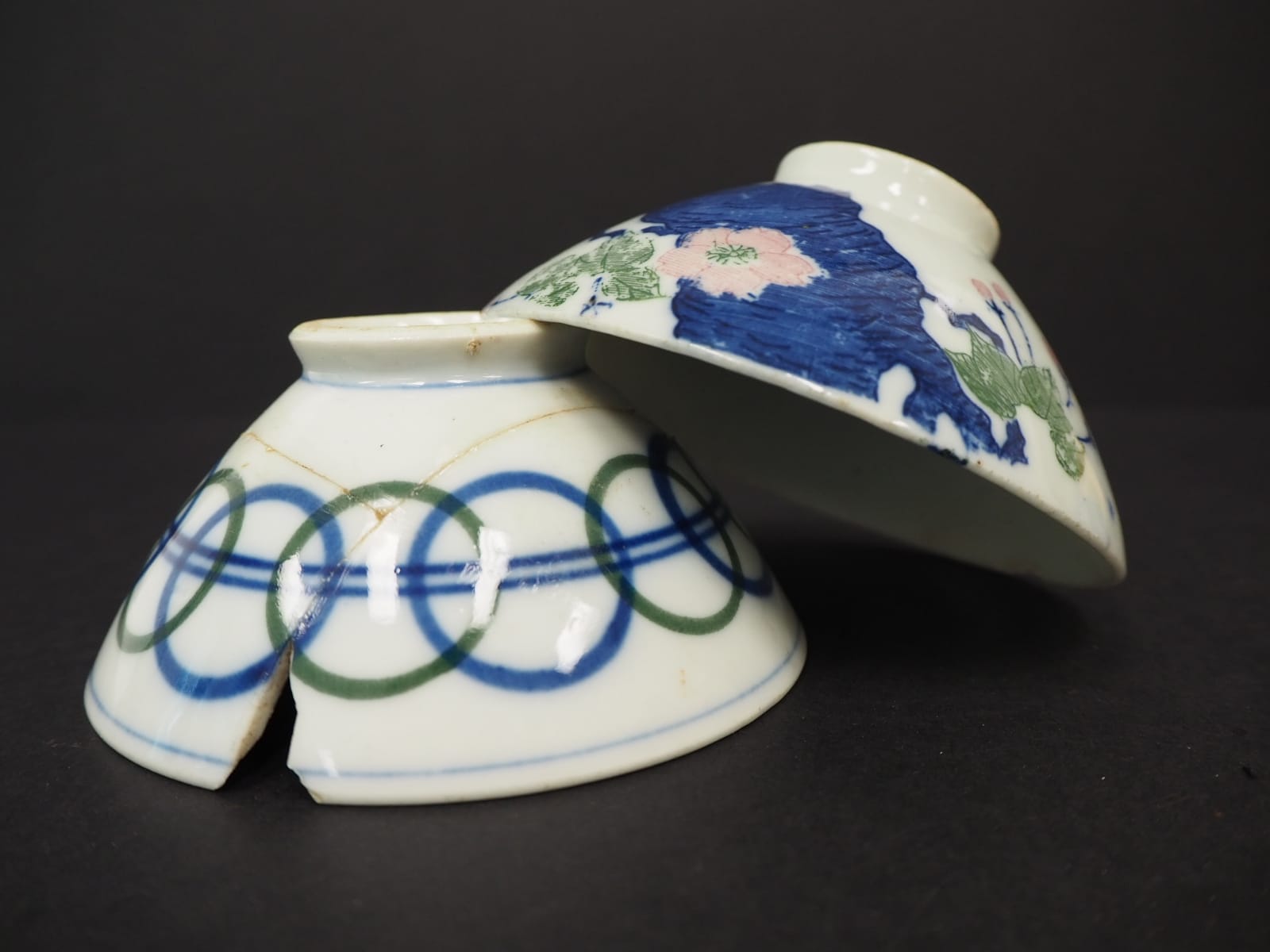
Bowls from the Suicide Creek site. Photo by Nikki.
A bowl from the Suicide Creek site. Photo by Nikki.

Tomorrow students will be back in the field once more to possibly finish up excavations. We are all hoping for dry weather, and to find some cool artifacts. See you tomorrow!