Showing posts with label Artifacts. Show all posts

Jun 18, 2019

June 18th 2019 - Nikki the Photography Expert.

This morning four students came into the lab, a few others joining in the afternoon. Shaunti, Nikki, Sepideh and I all worked on our projects as the sun came out from behind the clouds.

Nikki worked on cataloguing artifacts found in the 2019 field season, and also distributed pictures to a few students of artifacts she captured in the past few weeks for their projects.
All of the artifacts found in 2019. Photo by Nikki.
Shaunti worked on writing up the report on all of the information about artifacts she has researched in the past few weeks. She is using some of Nikki's photos, including one of 'Stevens Comfort' foot warmer. Siobhan is also using some images from Nikki of ponds cold cream jars in her research report.
Stevens Comfort foot warmer. Photo by Nikki.
Ponds cold cream jars. Photo by Nikki. 
Sepideh got some images from Nikki to use in her video, while also working on sorting through level bags. Bob created a project for a few students to take one of each item from all level bags to keep in his collection, so the storage situation doesn't get out of control. Most bags contain multiples of nails, bottle glass and small metal fragments, and because they are all logged in level bag reports, there is no need to keep everything.

Angus came in this afternoon to start putting back industrial artifacts from the display case in the lab. When he was assigned his project on barrel rings and other metal artifacts, he put a bunch of them in a small display case at the back of the classroom. Because we are getting to the end of the term, him and others are beginning to clean up.
Display case of industrial artifacts.
I spent the day working on writing up a report on the blog. I looked into the statistics of the website and found it very interesting. It showed that most of the views on this blog come from within Canada, but people from other countries are also reading it. 
Working on today's blog post. 
How many views we have gotten from each country on the blog so far.
Tomorrow, some students will be going to try and find the Hastings Seymour Camp in the Lower Seymour Conservation Reserve, and others will continue to work on their projects.


May 27, 2019

May 27th 2019 - Bears?!?!

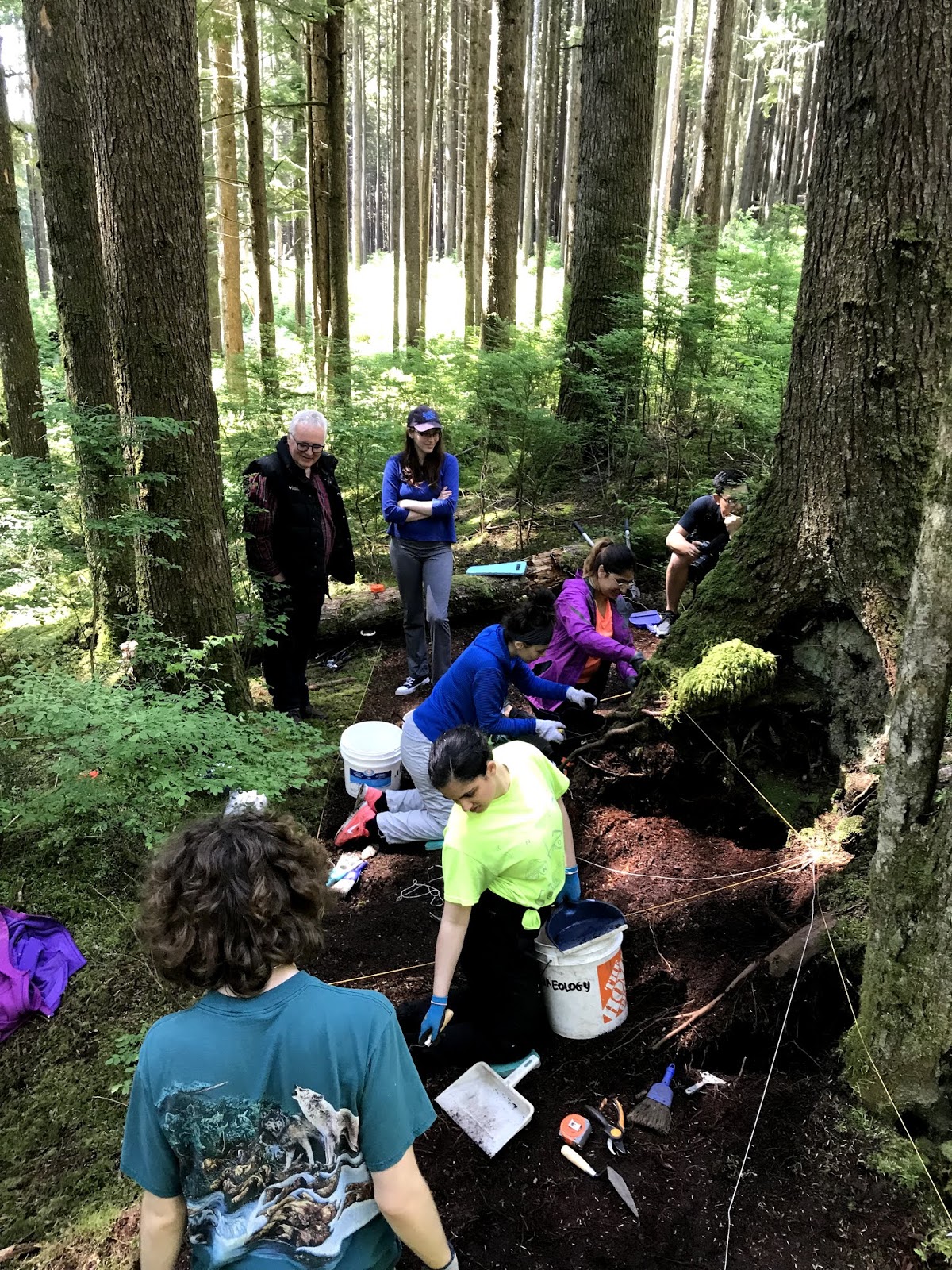
Today was an eventful day. We had a couple of guests come and check out the McKenzie Creek site, one of which was a bear that we were not expecting, but I will talk about that later in the blog post. In the morning, students broke off into many small groups to continue working on projects that were started last week, and to start some new projects that will be completed throughout the rest of the term. Mitch continued to excavate the rock feature on the north side of the camp while six other students continued to excavate their units on the south side.
Mitch excavating the Rock Feature.
Aza started her project on one of the wooden features at our site, the cedar plank road. She and a couple other students who were helping her today started to uncover the edges of the planks using brushes and trowels so that she could take measurements of the length and depth of the wood. While everyone was working on their projects, Karoline and I started to work on her second project. Along with the waste audit, Karoline is also describing and taking measurements of the old growth tree stumps on the McKenzie Creek site. We walked around all morning going to each giant stump and measured the height (usually in two or more places), the circumference, and identified all of the possible springboard notches in the stump. In total we found seven stumps spread out around the site.
Karoline Climbing a tree stump to take a peek inside.
The hollow inside of the tree stump above.
We both used our best climbing abilities when trying to measure the height, but it was very difficult to reach the top of the very wide stumps. The average height of the stumps on site is 2.4 meters, with a circumference ranging from 4.7 meters to 11.0 meters. Many of the stumps had second growth trees growing out of them, and a couple were hollow on the inside. A few of the trees also had a significant number of springboard notches. If you don't know what they are, springboard notches are chunks taken out of trees that were used to place springboards in the shape of stairs up trees so that loggers could climb them to cut the tree higher up. Loggers would prefer to cut old growth trees higher up because they are thinner, which makes them easier to cut down, and the base of the tree can contain rotten wood which wouldn't be useful to them. That also explains why some of the trees are hollow, because when they were cut down, all of the rotten wood in the middle would be exposed to the elements and quickly decompose.

We also had a guest visit us in the morning. Hailey Venn is a graduate History student from Simon Fraser University. She got a tour around the site and got to help do some excavations and sifting through dirt! We love having new people come and visit the site.
Bob and Hailey looking at three excavation units on the McKenzie Creek site.
We also had a photographer from Capilano University come and take some pictures of our site and the students working. Taehoon Kim is an amazing photographer who biked in with all of his equipment and walked around for about an hour capturing our working environment. If you want to check out the photos he took of the McKenzie Creek site, you can see them on Flickr here, and you can also check him out on instagram by clicking this link! It was a pleasure having him come for a couple hours, and the photos turned out wonderful!
Taehoon taking photos of students working in an excavation unit.
After lunch Roy Jantzen, the instructor in the Tourism and Outdoor Recreation department of Capilano University came to visit us. Many students who know him from the Global Stewardship program at the university were glad to see him, and many of us were also happy to meet him for the first time.
Roy and Bob talking on the cedar plank road. 
Students continued working on their morning projects after lunch, and Phoenix, Karoline and I measured out a new excavation unit that will be uncovered tomorrow. We used our measuring tape and string to plot two 2 meter by 2 meter units next to each other where Phoenix found some lantern and bottle glass this morning.
The excavation unit measured out by Phoenix, Karoline and I.
At the end of the day while everyone was filling in their yellow notebooks and packing up their bags, we had a bear come and visit our site. Earlier we were warned by some cyclists that there was a bear about a kilometre north of our site, but nobody got too worried. Someone pointed out that the bear was walking towards the tent on the cedar plank road at the end of the day, and soon after we all got up and walked up the skid road to avoid it. We watched as it dug through one students bag next to our picnic tables, and as it took our guest Hailey's bag off of a hook. We were all watching in amazement as it grabbed a bag off a hanging hook and dragged in 20 meters into the forest. Most students were then able to grab their backpacks from the picnic table area and make their way home, but unfortunately Bob, Hailey, Roy and a couple other students stayed behind to try and retrieve our guests bag. They waited until the bear backed away from the bag, with the yummy snacks hidden inside, to get it back. Everyone is safe and the park rangers were made aware of the bear, who clearly had no fear of humans.
The bear walking down the cedar plank road.
The bear trying to get snacks out of Hailey's backpack.
The blog Unwritten Histories is also following our blog every day, and if you are interested in checking out their page about interesting things in Canadian history you can see it here! Also if you are wondering how much walking the average student does in a day of field work, I took 18,500 steps today and walked a distance of 15.6 kilometres! Tomorrow we will be at the McKenzie Creek site again, continuing to excavate our units and touring a large group of students around the site.

May 22, 2019

May 22nd 2019 - Visitors Galore!

On this beautifully sunny day in North Vancouver, students once again met at the McKenzie Creek site in the morning. We all got our archaeology gear ready, and we were off to work! Everyone split into groups, and once again I got the opportunity to work with Alyssa and also Fazila on clearing moss off of the ofuro (Japanese bathhouse). Two other groups continued to dig test pits within the grid that was created yesterday, and Mitch continued working on clearing off the rock feature with Rohan and Harman. We also had four visitors join us in the morning from the North Vancouver Museum and Archive. Daien Ide, Karen Dearlove, Carol Ballard and Pamela Robertson took a tour around the site with Bob and got to look at artifacts from the McKenzie Creek collection. If you are interested in checking out the museum you can follow them on twitter here, or check out there website by clicking this link
Our morning visitors looking at artifacts found by previous field school students. Photo by Bob.  
Once everyone had spent a couple of hours working on their morning tasks, and the tour of our morning visitors was completed by Bob, we were called to lunch. Like most days at lunch we talked and joked around, but many students also began to fill in their field notebooks. Yesterday we were given tips from Bob on how we can individually improve our note taking skills, and many people were trying very hard to create the best notes they could.

In the afternoon, a few lucky students got to begin excavating 2 meter by 2 meter units. They began by removing the litter mat, which is all of the moss and twigs that cover the soil. While they were removing the upper layer, other students got to sift through it to make sure no artifacts were hidden within the moss. Once the litter mat was gone, students began excavating in the dirt slowly with their trowels, while the other students continued to sift through the dirt that was being taken out of the ground. 
One student excavating her 2m by 2m unit. Photo by Bob. 
While that was happening, Fazila, Alyssa and I were clearing the ofuro of moss and dirt. We used our trowels and brushes to gain better visibility of the rocks so that Alyssa can complete a more detailed sketch for her project.
The uncovered ofuro.
We also had another visitor join us in the afternoon who used to do archaeology with Bob many years ago, and is now a lawyer. Jane Luke was also given a tour around the site and helped do some tidying around the ofuro. Jane and Bob did a field project together many years ago and I hope that she enjoyed being an archaeologist again for the afternoon!
Jane helping out around the ofuro with her Marshalltown trowel.
Mitch also continued working on clearing the stone feature in the upper north side of the site. He also began some preliminary sketches of it to get a better idea of how the final drafts of his drawings will look. Ali, our site line drawer/sketcher also spent the afternoon sketching people working. Hopefully soon I can get some of those sketches to post on the blog. At the end of the day, we all packed up camp and made sure everything was secure for the weekend because we won't be back until Monday. Tomorrow students will be working on their projects in the lab and going over some excavation procedures. 
Don't forget to check out the different projects that students will be completing during the Lower Seymour Archaeology Project 2019! You can find that information on the right hand side of the blog or by clicking here!


May 21, 2019

May 21st 2019 - We're Back!

After a nice long weekend, we're back working in the field. In the morning we split into three groups to start planning out where our test pits were going to be, and measured out different grids around the site. One group worked on the west side of the paved road, while the other two worked on the east side of the path. My group created a grid which was 20 meters North/South by 35 meters East/West, placing a marker every five meters.
Students measuring out a grid system to create test pits at the McKenzie Creek site.
We also had our first visitors come to the site this morning which was super cool! Our guests included Christina Crane Finlay, Shane Finlay and Steph Halmhofer. Christina works at the National Trust in the United Kingdom and studies many important sites such as Stonehenge. Her husband Shane has a degree in cultural anthropology, but we forgave him for that and let him help excavate anyways. Steph is a bioarchaeologist who has a masters degree from the University of Toronto and you can check her out on twitter here!
From left to right: Christina, Shane, Steph. 
Bob gave our guests a tour of the McKenzie Creek site and showed them some artifacts that had been found in previous years.
A few artifacts found by previous field school students including a large bottle, a few smaller bottles, some ponds cold cream containers and some bowls. 
After lunch, we split up into a few more groups to continue test excavations around the site, and two students also started working on their projects. Mitch and Alyssa started planning out their sketches of the rock structure and ofuro, and also started to remove moss from those features. Rohan helped Mitch with some measurements and planning at the stone feature, while Alyssa and I worked on the ofuro. Before disturbing the features, we both got our site photographer Nikki to take detailed pictures of them, and we sketched them in our field notebooks. By the time Alyssa and I started clearing the moss off of the rocks making up the ofuro structure, everyone was packing up to leave for the day! Time goes by so fast and I wish I could have stayed longer to uncover the ofuro!
A single rock on the ofuro with the moss scraped off, many still covered around it. 
Luckily we will be back at the site tomorrow to continue with our test pits, and even start excavating! Soon everybody will be working on their projects and hopefully discovering many interesting things about the site. See you tomorrow! 


May 15, 2019

May 15th 2019 - Assigning Projects

Everyone met in the lab today to discuss many important topics such as student projects and excavation objectives. To start off the day, we took all McKenzie Creek artifacts out of the lab storage room and placed them on to tables. We also removed all field notebooks and written projects from past years for students to look at later in the day.

Artifacts including cans, bottles, ceramics and industrial materials removed from boxes.
After everything was organized, students sat down and Bob went around explaining each 2019 student project to us. Every student is working on one project for the next several weeks, which include things like artifact cataloguing, estimating the minimum number of bottles and lanterns on the site, and writing up detailed descriptions of features and artifacts. I have created a separate page that can be found on the right hand side of the blog, or by clicking this link. That page labelled "Information about Student Projects" details all of the projects and the students who will be working on them. Future blog posts will contain updates on those projects.
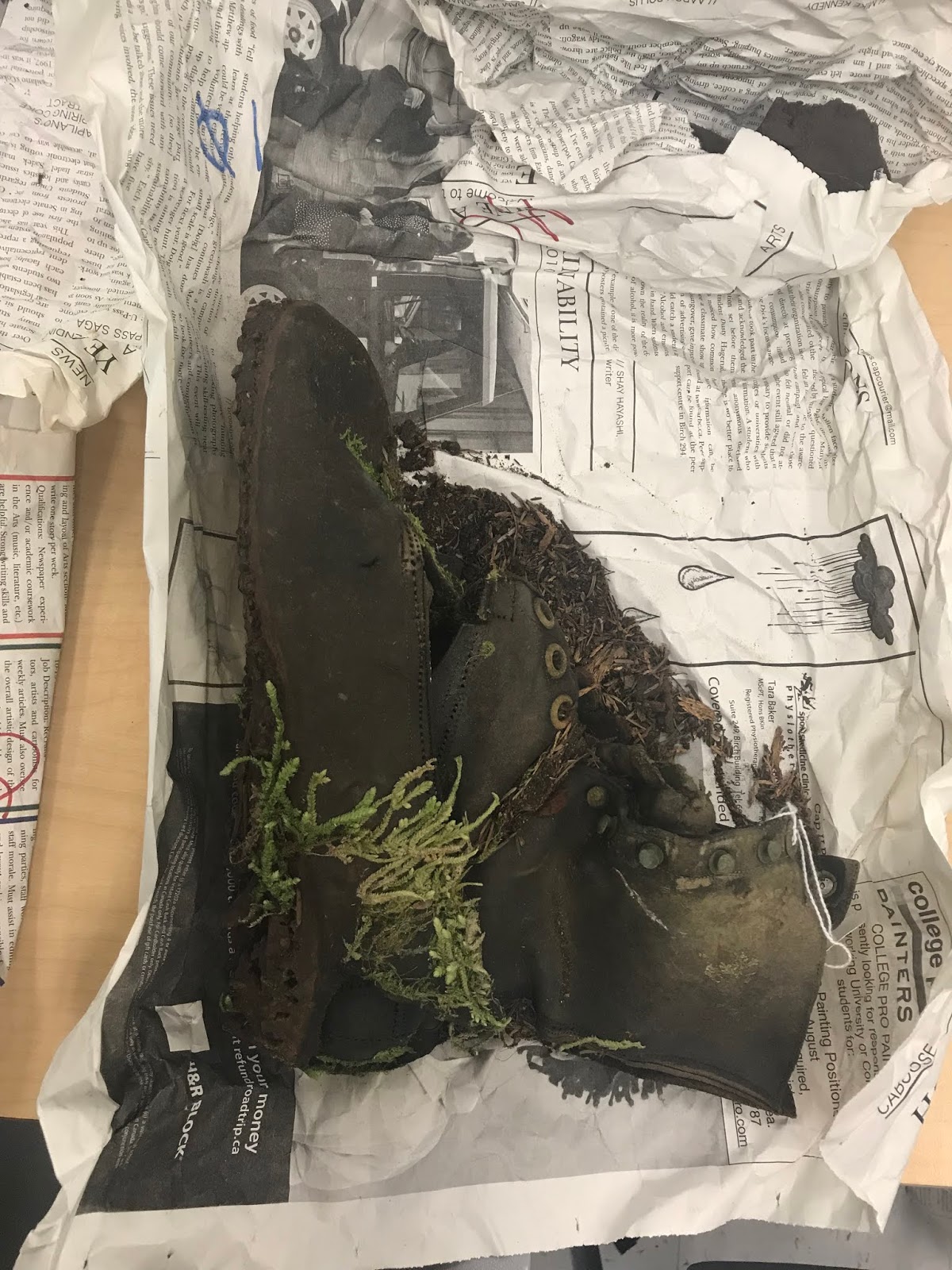
Other than the assignmemts listed on that page, possible ones for students to complete during the field school include finding a minimum number of cans on the site, collecting and dating ponds cold cream jars and studying shoes and boots.
Two tables full of shoes found by past field school students.
When all of the projects were designated, and students were clear on the main goal of their task, Bob started to explain the objectives of our 2019 excavations. The hypothesis for the McKenzie Creek site is that people continued to live there after its initial use as a logging camp for a few years around 1920. It was supposedly used as a secluded residential camp until the 1942 internment of Japanese people in British Columbia. Our main goal is to find evidence that can date people living there in the late 1920s and 1930s. We are also looking for proof of women and children living at the camp. So far, the only substantial evidence we have of women living there is a shawl pin. One more thing that we are looking to identify while studying the site is evidence that shows a clear presence of national identity by the Japanese. Hopefully we will find those things in the next five weeks, and help solidify Bob's hypothesis of the McKenzie Creek site.
We took a lunch break, then continued to look at artifacts found by previous field school students. Bob moved across our long table filled with artifacts and picked out a few items. He provided us with more details about them, and found some items that he wants more research conducted on by students.
A few of the cans found at the McKenzie Creek site. Cans mostly held food or evaporated milk, but some remain unknown due the condition they're in. 
A shoe that was found above ground on the site. Most shoes were found underground during excavations, but this was found on the surface. 
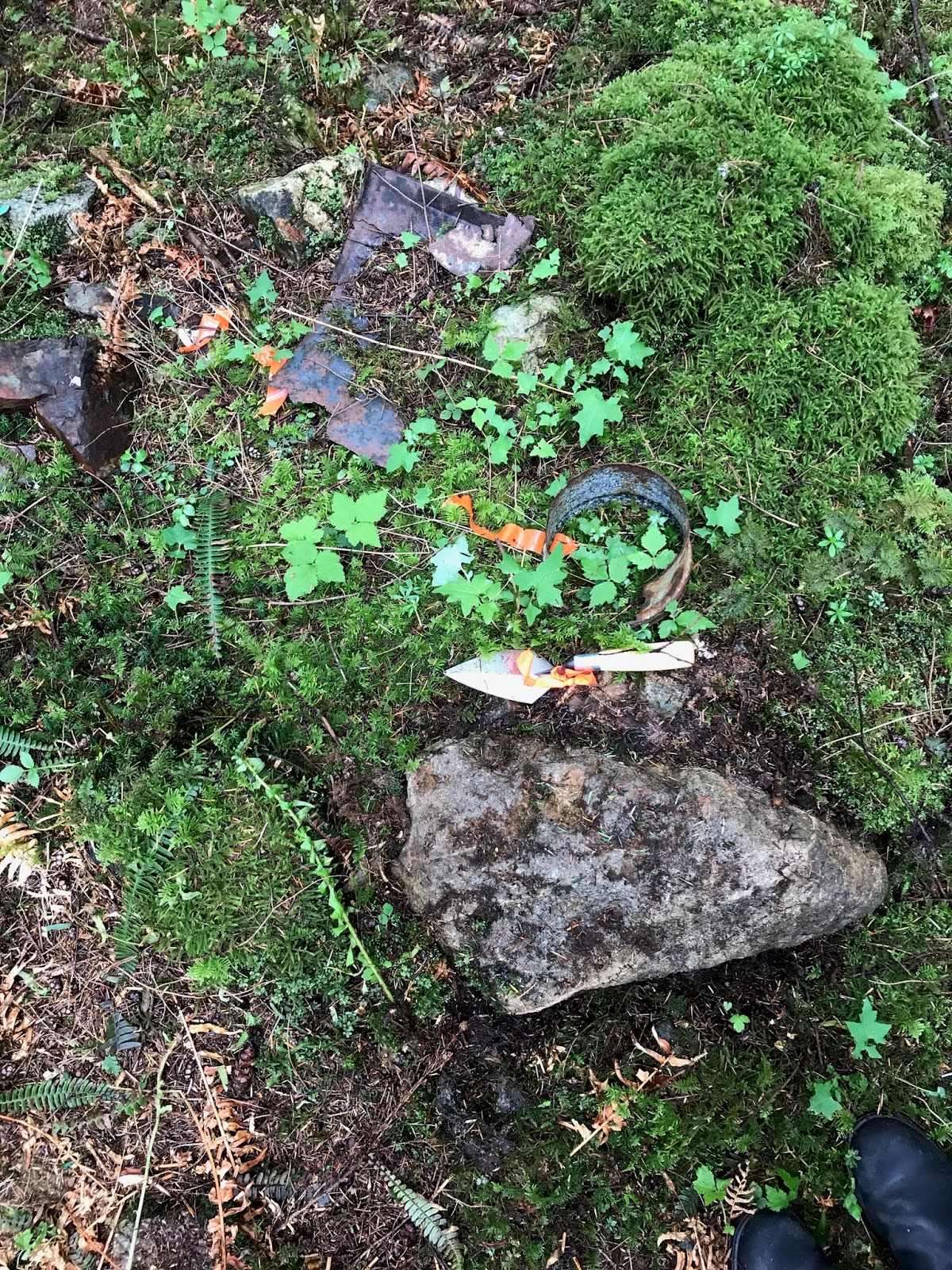
Industrial metal pieces that include a saw blade, parts of stoves, and files to sharpen tools.
Some metal pieces, featuring a mostly intact kettle.
Once Bob was done describing some important pieces, students were instructed to find materials that would help them with their projects. We all then split up and found things that would give us background information on our projects, whether it was past projects on the same topic, or artifacts found by previous students that relate to what we're studying. 
At the end of the day, we packed everything back into their boxes and placed them in storage to be examined later. Our plan for tomorrow is to finish clearing the last bit of foliage off of areas we will be studying at the McKenzie Creek site, then do a complete surface survey in groups of two or three. We will be flagging and recording everything found on the surface, then possibly starting some test excavations. If we run out of time to do test excavations tomorrow, we will start them early next week.

Don't forget to check out the list of 2019 student projects on the right hand side of the page labelled "Information about Student Projects" or by clicking this link!


May 9, 2019

May 9th 2019 - A Day in the Lab

All students met in the classroom today, relieved that we didn't have to endure the long walk to the McKenzie Creek camp again, but excited to start work in the lab. Firstly, while waiting for all students to arrive, we unloaded artifacts and past student projects about the McKenzie Creek camp from the lab storage room onto a few of our classroom tables to sort through later.

Boxes of artifacts and student projects associated with McKenzie Creek Camp from past seasons.
Once everyone got to the lab, Bob talked about a very important topic in archaeology, and many other fields. He provided a worksheet and explanation of the archaeology field school sexual harassment policy. We were informed of the history of sexual harassment in archaeology, what is defined as sexual harassment, and multiple people to contact if we ever wanted to report an incident. A zero tolerance policy was also applied for any other type of harassment in the work place such as discrimination against ethnicity, disabilities or religion. After that very important topic was covered, we moved on to assigning projects to students who did not yet have one.
Multiple project ideas were proposed by Bob and other students, some more creative than others, such as an interpretive dance or play. Those ideas were dismissed after considering the logistics of them, but others were picked up by students. Some were assigned specific artifact research, where they will find out as much information as they can about excavated artifacts, and another student will be sorting and classifying tableware found from the site. Bob also mentioned that the "absence of evidence isn't evidence of absence" when referring to items that have yet been discovered, but are presumed to have been in the McKenzie Creek camp during the time period being studied, such as eating utensils. Some projects will require more research in the field than others, but the time spent on each should be approximately equal, making it fair for all students. In a week or two, there will be a full page accessible through the right sidebar of the blog with the students and the projects they will be working on, and each will have a few sentences describing the goal of the project.
After everyone was assigned a project, Bob discussed the possibility of visitors coming to see our work at the McKenzie Creek camp. Some requests have been made by community members and school groups to see our site, which are happily accepted if, for the most part, the groups can get to the site on their own. If you are an archaeologist, historian or have any interest in the Japanese history in the LSCR and are from the lower mainland, you can message Bob on twitter (@bobmuckle) to see if you would be able to come for a site visit.
After a half-hour lunch break, where some students decided to soak up the sun rays outside, we all gathered back in the classroom to discuss archeology lingo and unpack some boxes that were taken out of storage to put on display.
All students were given a worksheet with words and abbreviations that we should be familiar with before we start excavations. General terms such as prehistoric archaeology versus historic archaeology were discussed, terms such as provenience, meaning the precise three-dimensional location of an object, and the acronym DBS, standing for depth below surface. I am sure by the end of next week, all students will be comfortable using the words given to us.
Once the quick vocabulary lesson was over, all students began to unpack boxes full of beer bottles, ceramic dishes and smaller containers used for creams and skin care.
Students unpacking bottles from a box.
Once most items were unpacked onto tables, a few students and the project director started to neatly display them in the glass display case outside of the classroom.
Bob and a student displaying items outside of the classroom.
Most bottles and dishes were placed in the display case outside, but unfortunately we ran out of time to go through other artifacts such as shoes and metals, so we will be unpacking and examining those in another lab period.
On Monday we will be in the field clearing moss and fallen branches off paths and features so we can get easier access to the items we are studying in the coming weeks. The next blog post will be Monday evening. 

May 8, 2019

May 8th 2019 - Set Up Base Camp

We had a busy and productive day today! It started off with most students meeting at the base of the trail which leads to McKenzie Creek camp. Two of the students met Bob at Capilano University to help load the truck containing our site equipment, and drove up into the LSCR with him. The walk is about an hour from the beginning of the trail, which most students completed with ease, but the swarming flies and mosquitoes did add an extra challenge to the day.
Students walking to the McKenzie Creek Camp.
Once we all arrived at the site, we were instructed to help Bob load all of our equipment down the path to our camp. The equipment included two large metal boxes with tools used daily inside, the metal poles and tarps for a tent, and a few buckets. One of the buckets will be used for collecting garbage from student's lunches and trash produced by the project itself, which will be analyzed by Karoline who is doing a waste audit as her project.
Students unloading supplies out of the van. 
Everything was then unloaded, and Bob left us to return the pickup truck to the Capilano University Campus, and told us to set up two tents. After sorting out the poles to make sure everyone had enough to build two separate tents, we split into two groups, and two students also started to build stairs along the path we get into camp with each day. Each group was responsible for building one tent, and after struggling for about half an hour, both groups figured out how to build them with very little instruction.
One group trying to figure out how to build the frame of a tent.
Both tents were successfully put up before Bob got back about an hour after he left, which he mentioned had never happened before. After a short snack break, two picnic tables were constructed so when we arrive at camp everyday, we can place our bags on them and eat lunch in that restricted area. It was also mentioned that if we were to eat anywhere else, the site could be contaminated with organic remains which most people hadn't thought of until Bob brought it up. Clearly, most of us are new at this.
Construction of our brand new picnic tables.
After our beautiful new picnic tables were assembled, we sat down and enjoyed our lunch. The flies that were constantly swarming us may have gotten into some of our food, but it could be good to take in some extra protein due to the long walks we have in and out of the site everyday. After lunch, Bob gave us a walking tour of the site that we will soon get to know very well. There were many cool features found by previous students which were shown and explained to us on our little journey. The first two things mentioned were the trails leading into our camp. One is a road made from cedar planks that runs for many kilometres, through our camp and all the way up Seymour mountain.  It was supposedly created by Eikichi Kagetsu, a prominent Japanese logger who is best known for his work on Vancouver Island. Bob had communicated with his son for about three years from 2002 to 2005 and shown through the sons research, it is possible that Kagetsu could have been logging there anywhere from 1916 to 1924. The precise location of Kagetsu's logging operations in the Seymour Valley is still uncertain.
Cedar plank road running through the McKenzie Creek camp.
Another path pointed out by bob was the skid road we walk to get into camp from the main trail. This was most likely used by people to move around within the camp.
Skid road.
We took the mostly overgrown cedar plank road up North a few meters to find features excavated by previous field school students. Since it has been 6 years since the last field school in 2013, many small and large trees have fallen down over the site. We walked over and around all of the obstacles to find our first feature. At the top of the path where most loggers would walk in from lot 922, a well known logging camp up the cedar road, a stone structure was built. The exact use is unknown, but it is presumed to be some sort of shrine that people could visit before they enter their home. In other field studies, students had found a coiled spring and green glass in the corner of the stone structure, which was identified to most likely be a lantern.
Possible shrine found along the cedar plank road.
After discussing the possible shrine, students walked over to one of the most important cultural finds on the McKenzie Creek camp, the Ofuro. This traditional bathhouse was created by Japanese people at most of their home camps. It is identified by its rectangular shape with an open end to add fuel to the fire underneath the tub, and by the ladle and water basin found next to it that were used to wash off before getting into the communal bath. The bathtub was constructed out of a metal bottom and wooden side planks. Usually a stool was placed inside of the tub so you didn't burn your feet on the metal bottom which layer directly over the fire underneath. A chimney glue was also found on the back end of the Ofuro which was used to release smoke from the fire, and to make sure the fire that warms the water can get enough oxygen to stay lit. Thousands of nails were also discovered by a previous group, showing that at one point a wooden structure stood around the tub for privacy.
Bob standing with the Ofuro. He is standing in the end that would have been open to fuel the fire which warms the water in the tub. The metal pieces shown in this picture are parts of a saw most likely used for cutting wood. 
Once the students, and Bob were done awing over the Ofuro, we moved over to the next feature which also has an unknown purpose. A hole in the ground lined with cedar planks and rocks sits very close to the Ofuro. Bob suggested that it could have been used for cold storage, and there is also evidence that a structure was once built around it.
Possible cold storage pit. 
Another interesting feature one of Bob's past students discovered is a possible garden. The area is very flat land compared to the rest of the site, and the soil pH was tested here and in a few other places around the camp which showed it had a much higher pH than anywhere else. High pH soil is good for growing food and flowers. The raise in pH is due to the crushed bone scattered in that area of the soil, which was most likely deliberately sprinkled there for the garden.
Bob and students standing in possible garden.
Once we were finished in the garden, we viewed out last feature of the day which was the privy. A giant hole in the ground shaped like a rectangle was used as a bathroom by the Japanese people at the McKenzie Creek camp and trash was also occasionally thrown down there. Many fully intact bottles were found at the bottom of the privy, most likely because when they were thrown down they had something soft to land on. The size of the privy helps us conclude that there were most likely 3 holes for use and nails show us a wooden structure built around it.
Large rectangular privy. 
One more cool artifact found by some of Bob's past students was an old stove, which. retailed at about 35 dollars in the 1920s, which was very expensive in comparison to the other 3 dollar stoves found. The stove, which was moved from the McKenzie Creek camp to behind an old growth tree off of the path, was most likely hidden from looters before the Japanese were forced into internment camps. Pieces were brought back after excavation and a catolaugoe of the item so it was easier to spot as students were given tours of the area.
Piece of the expensive stove.
The tour was then complete, and the two students who were building the stairs went back to finish those while the rest started to clear paths and finish attaching the last few screws on the picnic benches. After we finished our activities, we gathered at the tables to fill in our field notebooks for the day. Bob explained a little bit more about what we should write in our books, and everyone finished their daily entry.
Stairs created by students which are used to walk into the site from the main road.

My waterproof field notebook.
Tomorrow we will be back in the classroom/lab to ensure everybody gets a project to complete during the term. Feel free to leave any comments on the blog if you have any, I will do my best to reply and if any questions arise that I cannot answer, I will consult with our project director Bob.