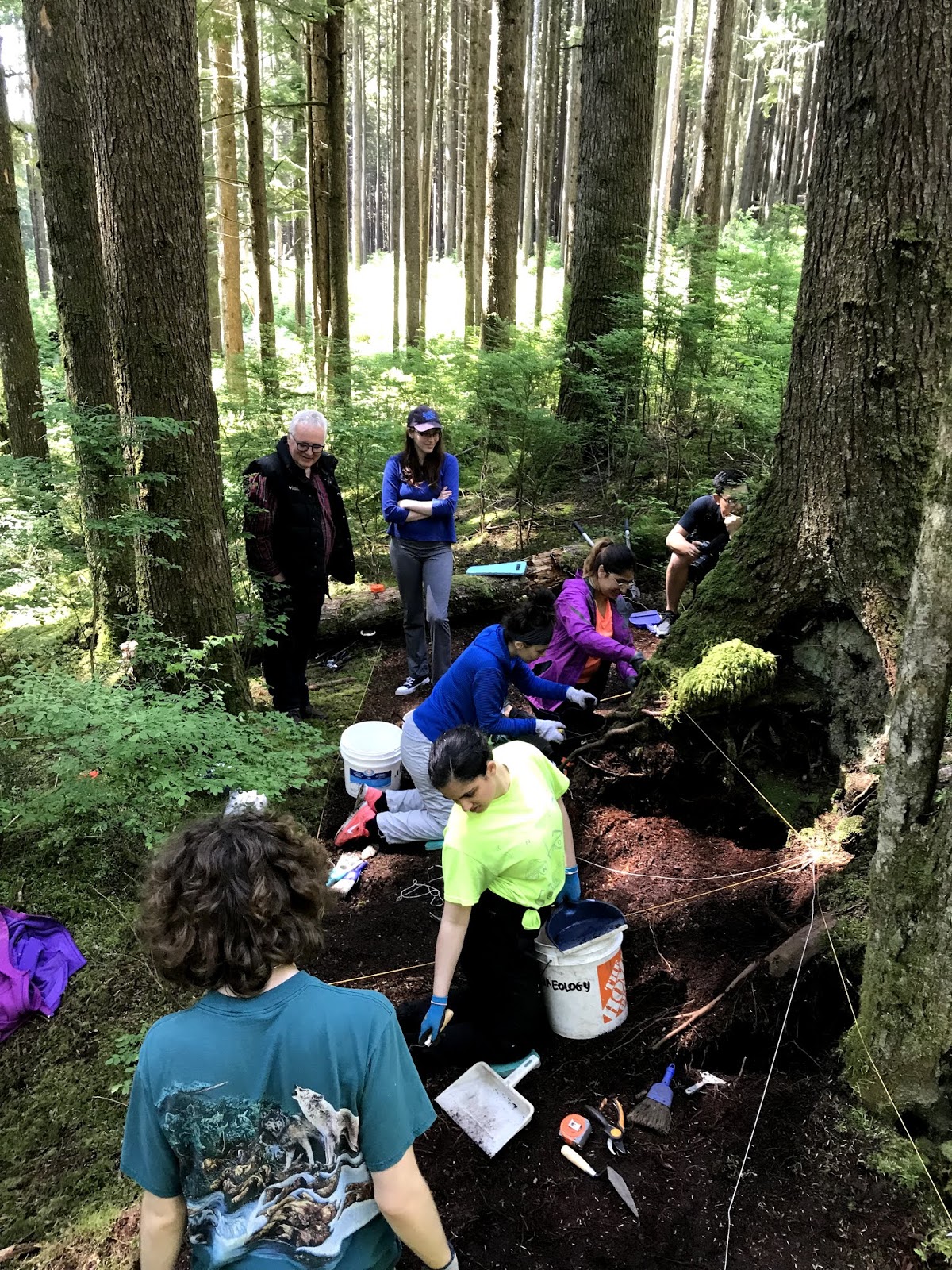
Today was an eventful day. We had a couple of guests come and check out the McKenzie Creek site, one of which was a bear that we were not expecting, but I will talk about that later in the blog post. In the morning, students broke off into many small groups to continue working on projects that were started last week, and to start some new projects that will be completed throughout the rest of the term. Mitch continued to excavate the rock feature on the north side of the camp while six other students continued to excavate their units on the south side.
 |
| Mitch excavating the Rock Feature. |
Aza started her project on one of the wooden features at our site, the cedar plank road. She and a couple other students who were helping her today started to uncover the edges of the planks using brushes and trowels so that she could take measurements of the length and depth of the wood. While everyone was working on their projects, Karoline and I started to work on her second project. Along with the waste audit, Karoline is also describing and taking measurements of the old growth tree stumps on the McKenzie Creek site. We walked around all morning going to each giant stump and measured the height (usually in two or more places), the circumference, and identified all of the possible springboard notches in the stump. In total we found seven stumps spread out around the site.
 |
| Karoline Climbing a tree stump to take a peek inside. |
 |
| The hollow inside of the tree stump above. |
We both used our best climbing abilities when trying to measure the height, but it was very difficult to reach the top of the very wide stumps. The average height of the stumps on site is 2.4 meters, with a circumference ranging from 4.7 meters to 11.0 meters. Many of the stumps had second growth trees growing out of them, and a couple were hollow on the inside. A few of the trees also had a significant number of springboard notches. If you don't know what they are, springboard notches are chunks taken out of trees that were used to place springboards in the shape of stairs up trees so that loggers could climb them to cut the tree higher up. Loggers would prefer to cut old growth trees higher up because they are thinner, which makes them easier to cut down, and the base of the tree can contain rotten wood which wouldn't be useful to them. That also explains why some of the trees are hollow, because when they were cut down, all of the rotten wood in the middle would be exposed to the elements and quickly decompose.
We also had a guest visit us in the morning. Hailey Venn is a graduate History student from Simon Fraser University. She got a tour around the site and got to help do some excavations and sifting through dirt! We love having new people come and visit the site.
 |
| Bob and Hailey looking at three excavation units on the McKenzie Creek site. |
We also had a photographer from Capilano University come and take some pictures of our site and the students working. Taehoon Kim is an amazing photographer who biked in with all of his equipment and walked around for about an hour capturing our working environment. If you want to check out the photos he took of the McKenzie Creek site, you can see them on Flickr
here, and you can also check him out on instagram
by clicking this link! It was a pleasure having him come for a couple hours, and the photos turned out wonderful!
 |
| Taehoon taking photos of students working in an excavation unit. |
After lunch Roy Jantzen, the instructor in the Tourism and Outdoor Recreation department of Capilano University came to visit us. Many students who know him from the Global Stewardship program at the university were glad to see him, and many of us were also happy to meet him for the first time.
 |
| Roy and Bob talking on the cedar plank road. |
Students continued working on their morning projects after lunch, and Phoenix, Karoline and I measured out a new excavation unit that will be uncovered tomorrow. We used our measuring tape and string to plot two 2 meter by 2 meter units next to each other where Phoenix found some lantern and bottle glass this morning.
 |
| The excavation unit measured out by Phoenix, Karoline and I. |
At the end of the day while everyone was filling in their yellow notebooks and packing up their bags, we had a bear come and visit our site. Earlier we were warned by some cyclists that there was a bear about a kilometre north of our site, but nobody got too worried. Someone pointed out that the bear was walking towards the tent on the cedar plank road at the end of the day, and soon after we all got up and walked up the skid road to avoid it. We watched as it dug through one students bag next to our picnic tables, and as it took our guest Hailey's bag off of a hook. We were all watching in amazement as it grabbed a bag off a hanging hook and dragged in 20 meters into the forest. Most students were then able to grab their backpacks from the picnic table area and make their way home, but unfortunately Bob, Hailey, Roy and a couple other students stayed behind to try and retrieve our guests bag. They waited until the bear backed away from the bag, with the yummy snacks hidden inside, to get it back. Everyone is safe and the park rangers were made aware of the bear, who clearly had no fear of humans.
 |
| The bear walking down the cedar plank road. |
 |
| The bear trying to get snacks out of Hailey's backpack. |
The blog Unwritten Histories is also following our blog every day, and if you are interested in checking out their page about interesting things in Canadian history you can see it
here! Also if you are wondering how much walking the average student does in a day of field work, I took 18,500 steps today and walked a distance of 15.6 kilometres! Tomorrow we will be at the McKenzie Creek site again, continuing to excavate our units and touring a large group of students around the site.