May 29, 2019

May 29th 2019 - Tall Trees and Small Bees

Most people joined us in the field today, with only one student working in the lab. Harman is slowly working on her huge project, which cataloguing and organizing all artifacts from the McKenzie Creek site that have been found in the past, and continue to be found this season. So far there are almost 900 items on paper lists which she will be digitizing. While she was working in the lab, others split off into their groups in the field to continue working on excavations. Karoline and I walked an extra 6 kilometres from our site to a patch of old growth trees.
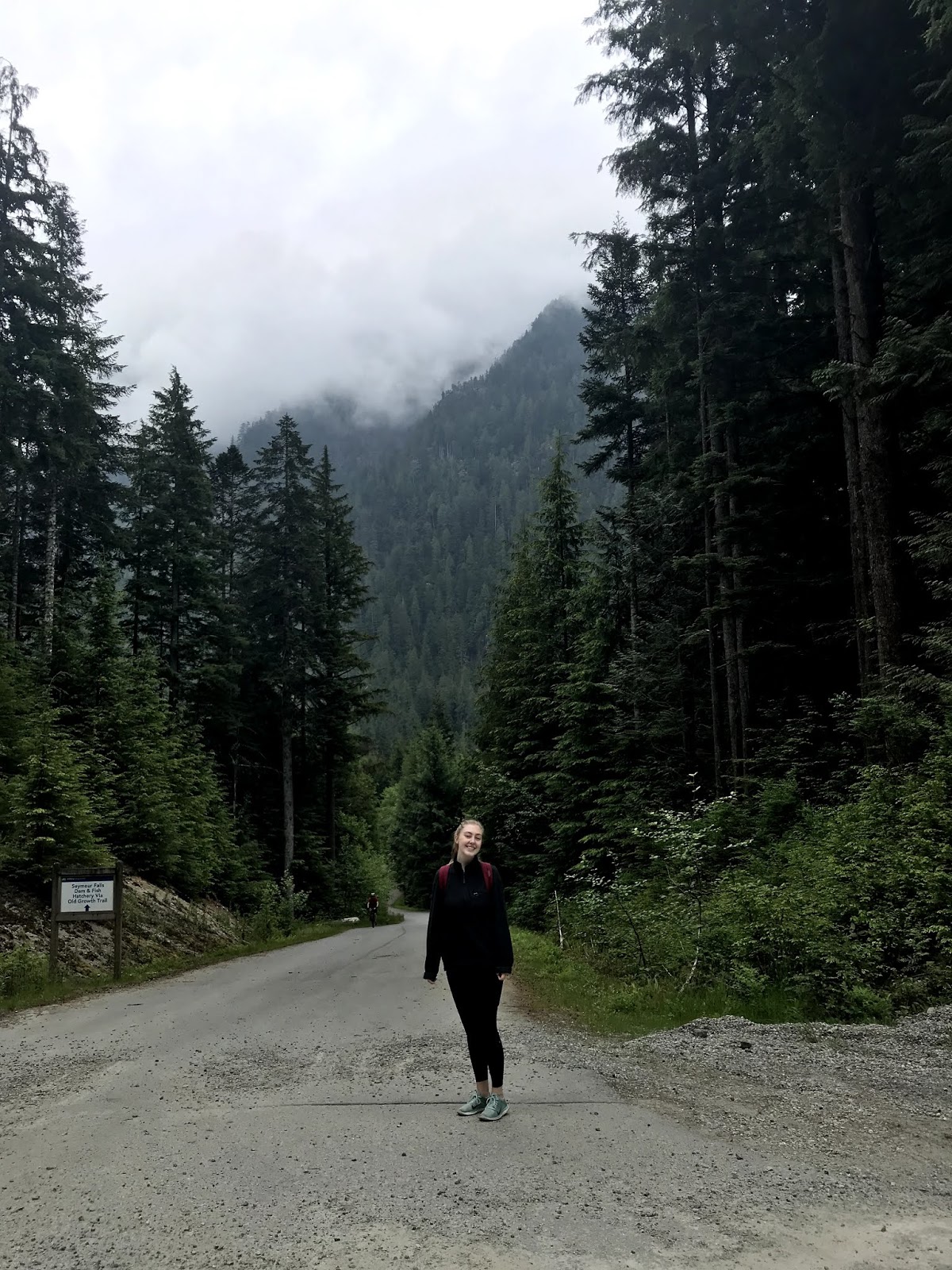
Karoline and the path we took to the reach the old growth trail.
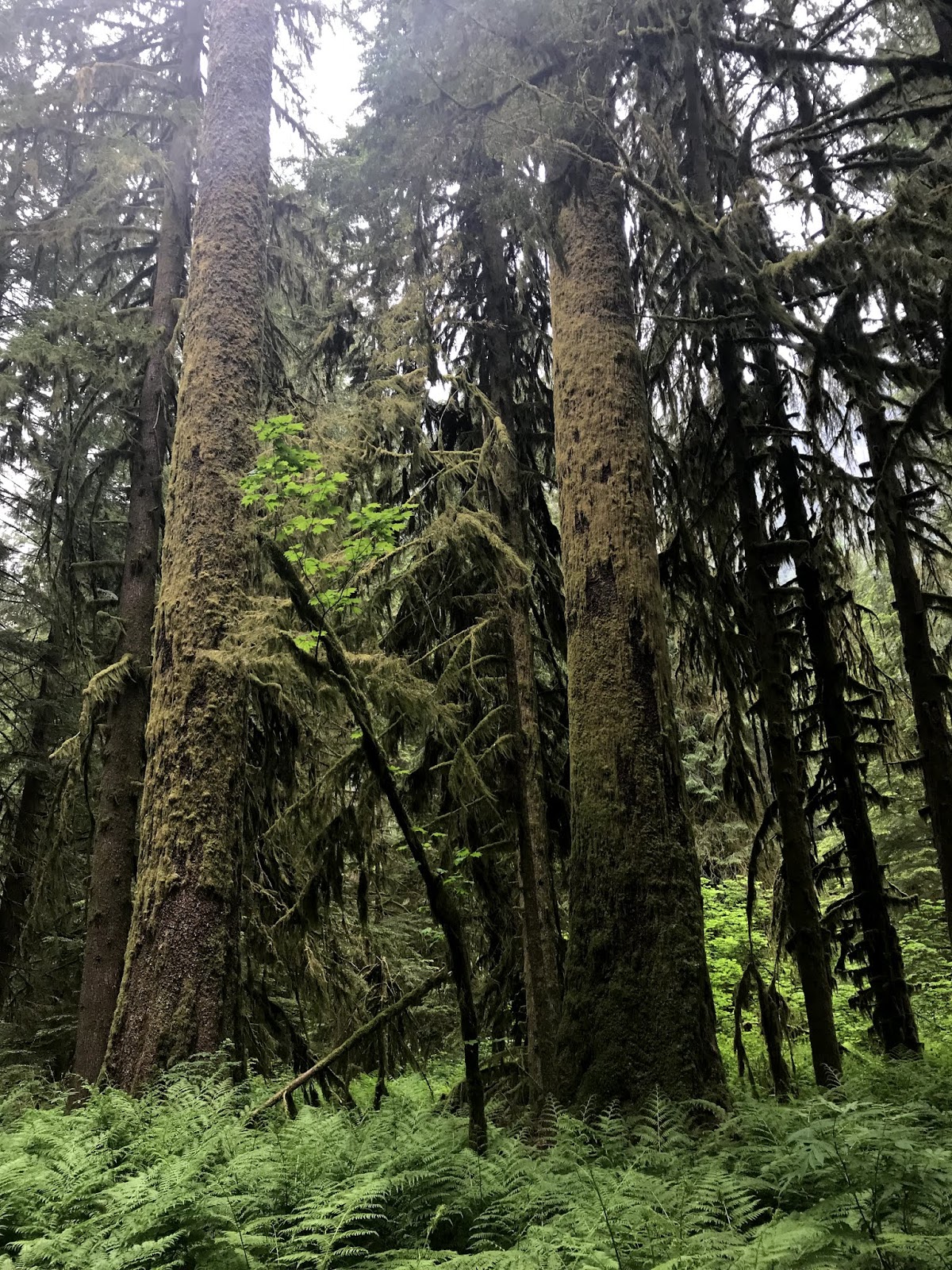
While travelling down the old growth trail, we saw large trees that had a significant sized base, but they weren't as large as the ones we recorded on Monday at McKenzie Creek. With our measuring tape, we checked the circumference of one red cedar tree that has been there for about 350 years according to an information board next to it.
Red cedar tree that Karoline and I measured. (7.1m circumference)
We measured a distance of 7.1 meters around the tree, which is the same as one of the smaller trees on our site. According the the information board, the average circumference of the old growth red cedar trees in the area is 5.5 meters, which is smaller than the average at our site. The largest circumference of an old growth tree on the McKenzie Creek site is 11 meters. We speculate that the difference in size may have to do with the elevation, or how close it is to the mountains on either side of the valley.
More trees on the old growth trail.
While we were looking for old growth trees, an archaeology field school from Simon Fraser University joined us at the McKenzie Creek site. Over 20 students and few professors got a tour from Bob. Currently they are just working in the classroom, but soon they will be working at a site in Courtenay British Columbia with the K'omoks First Nation band for six weeks. Their site will focus on the excavation of a large ancient village at the mouth of the Puntledge River. If you want to read more information about it you can check it out here. They had many great questions for Bob, and I hope that they enjoyed their time at our site. We also displayed some of the artifacts found at McKenzie Creek for the students and professors to look at.
The SFU archaeology field school group.
Display of artifacts found at the McKenzie Creek site.

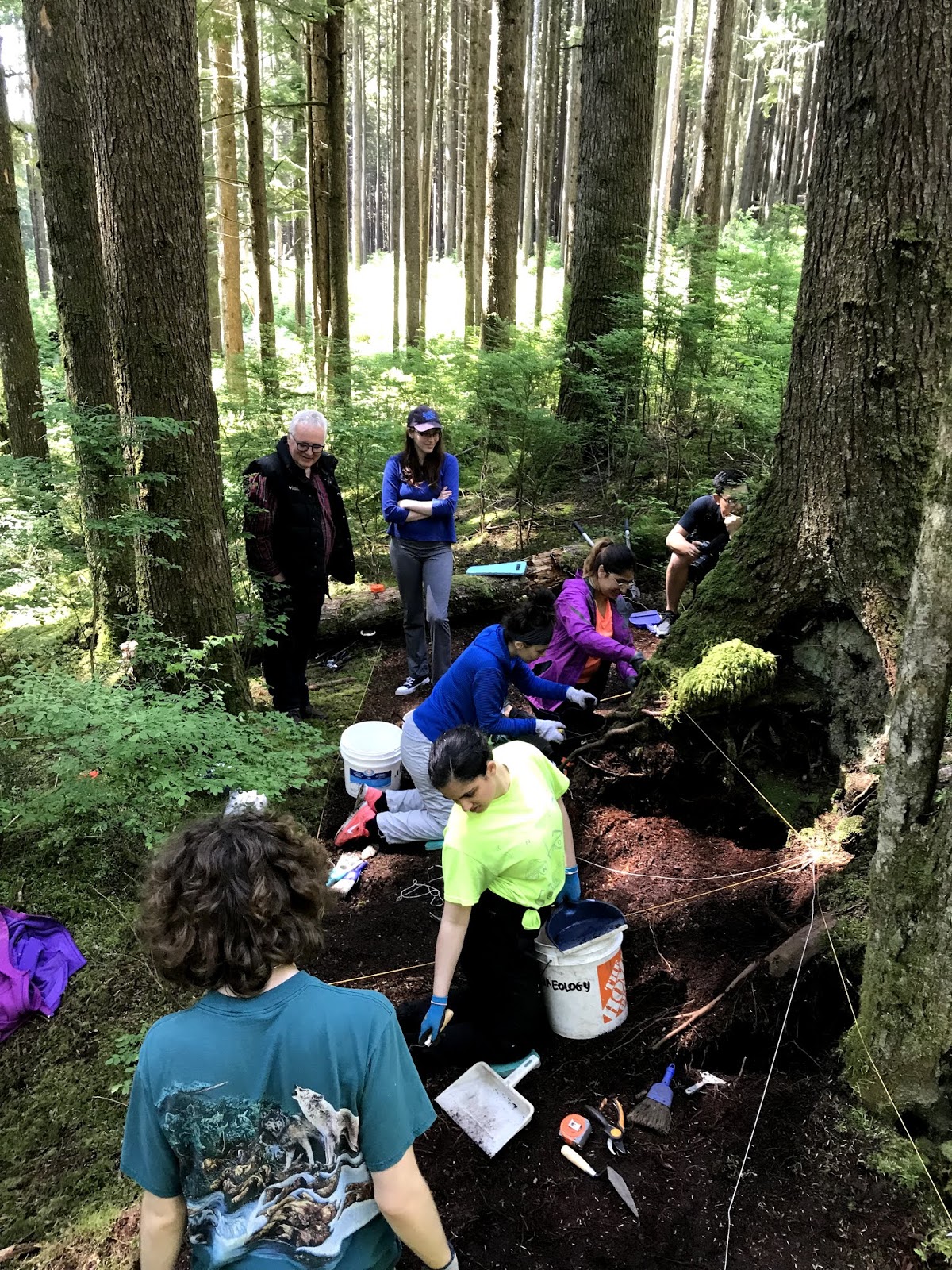
Once Karoline and I got back from our detour, we joined Phoenix and continued excavating our units. We found four nails, one small circular piece of metal and what seems like melted glass, all surrounded by charred wood. Other students on the site also excavated pieces of bottle glass and nails. Everyone is excited to get their turn excavating, especially with all of the exciting things being found everyday. One group has an especially hard excavation unit, which is filled with large tree roots. They are doing an amazing job working around the obstacles.
An excavation unit with large tree roots.
Alyssa and Siobhan worked on excavating a portion of the ofuro all day, and found lots of small pieces of metal buried within. Mitch and Ali continued to work on the rock feature, slowly digging out the walls that go deeper into the ground than expected.
Alyssa and Siobhan working at the ofuro.
Aza and Allyah were also working on the cedar plank road that runs through our site. They are trying to compare the road to pictures and notes from previous years to see how much it has changed since then. They are doing this by taking measurements of the wood without uncovering too much of it, to reduce possible decomposition. Aza is going to be creating a map of the cedar planks, which will include the depth and size of each plank. She is also hoping to find an average board size by the end of her project. We're all excited to see the final product!
A surface level cedar plank covered in moss. Taken by Aza.
We also kept our eye out for the bear today, and still haven't seen it since Monday when it ate somebody's lunch bag. New signs have been put up on the paved path near our site to warn other people of the possible threat. Tomorrow we are all in the lab working on our projects and sharing our progress with the group. 

May 28, 2019

May 28th 2019 - Bear Update


With the lingering threat of a possible bear attack today, some students worked in the lab while others took the risk of working at the McKenzie Creek site. The students who were in the lab today had a couple of projects to work on. Some began researching items found by past field school students, such as buttons and metal artifacts form the McKenzie Creek site. Sepideh, who is creating the video about our project worked on scanning some line drawings onto her computer so that she can add them into her creation. A couple of other students sorted through artifacts found on other sites that have been studied by Bob, such as Suicide Creek and the Martin/McKay site. They separated the glass and ceramics into organized groups so that Bob can view what the collection contains.

Bob and the nine students working in the field today continued to excavate the units that were created in the past few days. Phoenix, Karoline and I started excavation on the unit that we measured out yesterday by removing the litter mat.
Karoline in the newly created excavation unit. 
It took us all day to carefully scrape off the moss and twigs from the unit and sift through them to check for cultural debris. Luckily there was a giant fallen over log that was covered in soft moss so we were able to sit down for a lot of the sifting process. Before sitting down I did check to see if any glass or nails were on the log that could have possibly hurt us, but luckily there was nothing to be seen. We ended up finding multiple pieces of metal, bottle glass, lantern glass and a few nails just on the surface level!
Sitting down on the mossy log sorting through the litter mat.
Aza continued to work on measuring planks from the cedar plank road, and Angus started his project on barrel rings. He drew a map of the site and found all of the metal barrel rings that sat on the surface, recording them in his book and noting their location on his map. The last group of people on site kept excavating the three units that were created last week, continuing to work through the tough roots of a second growth tree that protrude into the space.

Now for an update on the Bear that came to visit our camp yesterday. This morning we arrived to see our roll of toilet paper on the ground with giant bite marks in it. Clearly the bear was very interested in this soft tissue. We also found the lunch bag that had been torn up and eaten by the bear, with empty plastic jam containers that had very large puncture marks on them from its teeth. Along with those two things, we also found bear feces next to the ofuro in the afternoon. 
Bite marks on our toilet paper roll from the bear.
A ripped up lunch bag that the bear took out of a backpack yesterday afternoon.
Bear feces next to the ofuro.

Bob and all of the students in the field were very aware of their surroundings, but the bear didn't come back for seconds today. From now on, all of our lunches and backpacks will be put in the trunk of Bob's car with the hope that the smell won't attract the bear again. Hopefully the bear won't disrupt any more of our excavations this season. 

Yesterday I mentioned that a few students would be touring around a large school group, but unfortunately due to the bear invading our camp, they had to cancel for the children's safety. Tomorrow we will be back in the field working on more excavations and student projects. Karoline and I will be hiking another five kilometres north from our site to visit a patch of old growth trees that still stand today, and a group of archaeology students from SFU will be visiting our site. You can read more about that experience tomorrow on the blog!  


May 27, 2019

May 27th 2019 - Bears?!?!

Today was an eventful day. We had a couple of guests come and check out the McKenzie Creek site, one of which was a bear that we were not expecting, but I will talk about that later in the blog post. In the morning, students broke off into many small groups to continue working on projects that were started last week, and to start some new projects that will be completed throughout the rest of the term. Mitch continued to excavate the rock feature on the north side of the camp while six other students continued to excavate their units on the south side.
Mitch excavating the Rock Feature.
Aza started her project on one of the wooden features at our site, the cedar plank road. She and a couple other students who were helping her today started to uncover the edges of the planks using brushes and trowels so that she could take measurements of the length and depth of the wood. While everyone was working on their projects, Karoline and I started to work on her second project. Along with the waste audit, Karoline is also describing and taking measurements of the old growth tree stumps on the McKenzie Creek site. We walked around all morning going to each giant stump and measured the height (usually in two or more places), the circumference, and identified all of the possible springboard notches in the stump. In total we found seven stumps spread out around the site.
Karoline Climbing a tree stump to take a peek inside.
The hollow inside of the tree stump above.
We both used our best climbing abilities when trying to measure the height, but it was very difficult to reach the top of the very wide stumps. The average height of the stumps on site is 2.4 meters, with a circumference ranging from 4.7 meters to 11.0 meters. Many of the stumps had second growth trees growing out of them, and a couple were hollow on the inside. A few of the trees also had a significant number of springboard notches. If you don't know what they are, springboard notches are chunks taken out of trees that were used to place springboards in the shape of stairs up trees so that loggers could climb them to cut the tree higher up. Loggers would prefer to cut old growth trees higher up because they are thinner, which makes them easier to cut down, and the base of the tree can contain rotten wood which wouldn't be useful to them. That also explains why some of the trees are hollow, because when they were cut down, all of the rotten wood in the middle would be exposed to the elements and quickly decompose.

We also had a guest visit us in the morning. Hailey Venn is a graduate History student from Simon Fraser University. She got a tour around the site and got to help do some excavations and sifting through dirt! We love having new people come and visit the site.
Bob and Hailey looking at three excavation units on the McKenzie Creek site.
We also had a photographer from Capilano University come and take some pictures of our site and the students working. Taehoon Kim is an amazing photographer who biked in with all of his equipment and walked around for about an hour capturing our working environment. If you want to check out the photos he took of the McKenzie Creek site, you can see them on Flickr here, and you can also check him out on instagram by clicking this link! It was a pleasure having him come for a couple hours, and the photos turned out wonderful!
Taehoon taking photos of students working in an excavation unit.
After lunch Roy Jantzen, the instructor in the Tourism and Outdoor Recreation department of Capilano University came to visit us. Many students who know him from the Global Stewardship program at the university were glad to see him, and many of us were also happy to meet him for the first time.
Roy and Bob talking on the cedar plank road. 
Students continued working on their morning projects after lunch, and Phoenix, Karoline and I measured out a new excavation unit that will be uncovered tomorrow. We used our measuring tape and string to plot two 2 meter by 2 meter units next to each other where Phoenix found some lantern and bottle glass this morning.
The excavation unit measured out by Phoenix, Karoline and I.
At the end of the day while everyone was filling in their yellow notebooks and packing up their bags, we had a bear come and visit our site. Earlier we were warned by some cyclists that there was a bear about a kilometre north of our site, but nobody got too worried. Someone pointed out that the bear was walking towards the tent on the cedar plank road at the end of the day, and soon after we all got up and walked up the skid road to avoid it. We watched as it dug through one students bag next to our picnic tables, and as it took our guest Hailey's bag off of a hook. We were all watching in amazement as it grabbed a bag off a hanging hook and dragged in 20 meters into the forest. Most students were then able to grab their backpacks from the picnic table area and make their way home, but unfortunately Bob, Hailey, Roy and a couple other students stayed behind to try and retrieve our guests bag. They waited until the bear backed away from the bag, with the yummy snacks hidden inside, to get it back. Everyone is safe and the park rangers were made aware of the bear, who clearly had no fear of humans.
The bear walking down the cedar plank road.
The bear trying to get snacks out of Hailey's backpack.
The blog Unwritten Histories is also following our blog every day, and if you are interested in checking out their page about interesting things in Canadian history you can see it here! Also if you are wondering how much walking the average student does in a day of field work, I took 18,500 steps today and walked a distance of 15.6 kilometres! Tomorrow we will be at the McKenzie Creek site again, continuing to excavate our units and touring a large group of students around the site.
May 23, 2019

May 23rd 2019 - The Excitement of Lab Days!

We spent the day in the lab and covered many topics in the hours that we were there. In the morning we started by talking about digitizing old archaeological records. Yesterday in the field, Bob was laughing because one student didn't know what a slide was, referring to photographs kept on slides that can be viewed through a slide projector. Most of the students are too young to have used them as children. When it was brought up this morning, it sparked a conversation about the vast amounts of records that are difficult to access due to the format they are stored on. In this day and age, it is difficult to view images that are stored on older technologies. Most new computers are made without a place to insert a CD or DVD, don't even try to find one that still takes floppy disks, and some even come without a place to attach a USB. As time goes on, everything seems to be uploaded to the cloud or some other type of online webpage. If you imagine yourself as an archaeologist in the distant future, you would piece together generations of people with no culture, who didn't do any art, and didn't even know how to write because nothing we create will preserve long enough to provide evidence for it.

After talking about our digital era, we got into a conversation about pseudoarchaeology. Bob explained how many people make a huge profit off of fake archaeology, whether it's through a book, television show or movie. A lot of archaeologists spend time trying to disprove these fake claims and stories, but the public loves to believe in things such as aliens creating the Egyptian pyramids. That also lead us to the topic of ways of knowing. After a student asked a question relating to why people believe in pseudoarchaeology, Bob explained that there are many different frameworks to base opinions off of when studying a subject. Humans can have many explanations for why a flower would grow in a specific place, depending if they base their reasoning off a scientific, religious, indigenous or any other other type of framework. The way you choose to view something all depends on how you grow up, what you study and what you believe.

Before lunch we also talked about the proper method of excavating. Bob spent about an hour detailing everything that we should know about excavating when we get the chance to do so at the McKenzie Creek site. The first thing he talked about was the standard excavation unit we will be using. A 2 meter by 2 meter unit is the Canadian standard, and we will be marking that area with string once it is measured out. Before any digging commences, the coordinates of our unit will be found by linking it with the site datum. A pit datum will also be created in the highest corner of the excavation unit. Attached to the pit datum will be a string that slightly extends the length of the unit so that we can attach a string spirit level to it, and make sure we are digging evenly across the entire unit. Next he explained that he will create arbitrary levels for each unit, and every new level will have its own level bag. Cultural items that are found in the ground that don't meet the criteria of an artifact for this project are put into a level bag, which is labelled with the site name, the coordinates of the unit, the name of the people working in the unit and a summary of what was found in that level. Bob also mentioned that it is very important not to step in anybody else's excavation unit. Only the people who work inside the unit are allowed in it, because you never know if they are in the middle of uncovering an important artifact. The last thing he mentioned that is of high importance is that the edges of a unit must always be straight! It is bad practice to have crooked lines, especially because you could be missing important artifacts, or be veering into another unit.
Bob talking about excavation units.
Another thing that was quickly mentioned before lunch is that the Burnaby Village Museum has a replica of an ofuro. Alyssa will most likely be taking a trip there sometime during the field school season to help her visualize what the bathhouse at the McKenzie Creek site could possibly look like. If you want to visit the Burnaby Village Museum and see the ofuro, check out their website here to see when they're open.

After lunch some people provided updates on their projects, and we made plans about next weeks schedule. We are expecting many guests to visit us in the coming weeks, so a few people also prepared for the groups who will be touring the site. On Monday, most of us will be in the field and some students who haven't gotten the chance yet, will be starting their term projects. See you on Monday!


May 22, 2019

May 22nd 2019 - Visitors Galore!

On this beautifully sunny day in North Vancouver, students once again met at the McKenzie Creek site in the morning. We all got our archaeology gear ready, and we were off to work! Everyone split into groups, and once again I got the opportunity to work with Alyssa and also Fazila on clearing moss off of the ofuro (Japanese bathhouse). Two other groups continued to dig test pits within the grid that was created yesterday, and Mitch continued working on clearing off the rock feature with Rohan and Harman. We also had four visitors join us in the morning from the North Vancouver Museum and Archive. Daien Ide, Karen Dearlove, Carol Ballard and Pamela Robertson took a tour around the site with Bob and got to look at artifacts from the McKenzie Creek collection. If you are interested in checking out the museum you can follow them on twitter here, or check out there website by clicking this link. 
Our morning visitors looking at artifacts found by previous field school students. Photo by Bob.  
Once everyone had spent a couple of hours working on their morning tasks, and the tour of our morning visitors was completed by Bob, we were called to lunch. Like most days at lunch we talked and joked around, but many students also began to fill in their field notebooks. Yesterday we were given tips from Bob on how we can individually improve our note taking skills, and many people were trying very hard to create the best notes they could.

In the afternoon, a few lucky students got to begin excavating 2 meter by 2 meter units. They began by removing the litter mat, which is all of the moss and twigs that cover the soil. While they were removing the upper layer, other students got to sift through it to make sure no artifacts were hidden within the moss. Once the litter mat was gone, students began excavating in the dirt slowly with their trowels, while the other students continued to sift through the dirt that was being taken out of the ground. 
One student excavating her 2m by 2m unit. Photo by Bob. 
While that was happening, Fazila, Alyssa and I were clearing the ofuro of moss and dirt. We used our trowels and brushes to gain better visibility of the rocks so that Alyssa can complete a more detailed sketch for her project.
The uncovered ofuro.
We also had another visitor join us in the afternoon who used to do archaeology with Bob many years ago, and is now a lawyer. Jane Luke was also given a tour around the site and helped do some tidying around the ofuro. Jane and Bob did a field project together many years ago and I hope that she enjoyed being an archaeologist again for the afternoon!
Jane helping out around the ofuro with her Marshalltown trowel.
Mitch also continued working on clearing the stone feature in the upper north side of the site. He also began some preliminary sketches of it to get a better idea of how the final drafts of his drawings will look. Ali, our site line drawer/sketcher also spent the afternoon sketching people working. Hopefully soon I can get some of those sketches to post on the blog. At the end of the day, we all packed up camp and made sure everything was secure for the weekend because we won't be back until Monday. Tomorrow students will be working on their projects in the lab and going over some excavation procedures. 
Don't forget to check out the different projects that students will be completing during the Lower Seymour Archaeology Project 2019! You can find that information on the right hand side of the blog or by clicking here!